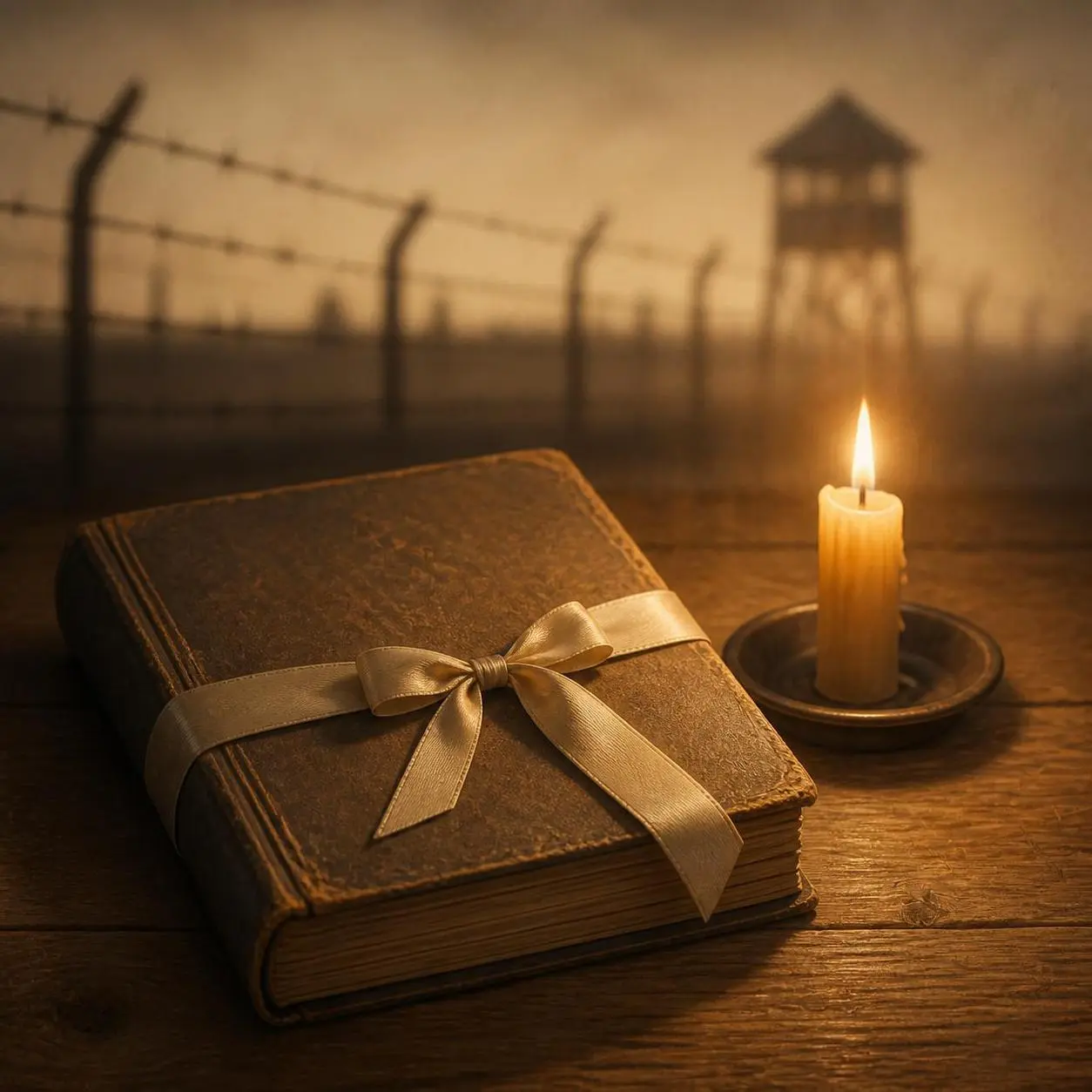
Anne Frank was a teenage girl with dreams like any other. She wanted to be a writer. She fell in love. She fought with her mother. She made jokes and observations about the people around her. Then the Nazis came, and her world compressed into a hidden room no bigger than a closet. What made her extraordinary was not that she survived—she didn't—but that she refused to let the system that imprisoned her erase who she was.
A Normal Life Before the Hiding
Anne was born in Frankfurt, Germany, in 1929 to Otto and Edith Frank. Her family was Jewish, comfortable, and assimilated. They had a business, friends, and a normal German life until Adolf Hitler came to power. By 1933, when Anne was just four years old, the laws began to change. Jews were slowly pushed out of German society through legislation that stripped them of citizenship, jobs, and basic rights.
The Frank family did what many Jewish families did: they fled. They moved to Amsterdam in 1934, hoping the Netherlands would be safer. For a few years, it was. Anne had a normal childhood. She went to school, made friends, collected movie star photographs, and developed the personality that would later fill her diary—curious, observant, prone to getting into trouble, and fundamentally alive in the way teenagers are alive.
But in May 1940, Nazi Germany invaded the Netherlands. The occupation was swift and brutal. Within months, the same anti-Jewish laws that had driven the Franks from Germany began to appear in the Netherlands. Jews were required to register. They were banned from schools, parks, swimming pools, and libraries. They had to wear yellow stars on their clothing. Their businesses were seized. Their world was being systematically dismantled.
For Anne, then ten years old, these restrictions were suffocating. She had to leave her school. She couldn't go to the cinema or ride her bicycle freely. She watched her father's business slip away. But worse than the restrictions was the fear. The Nazis were rounding up Jews across Amsterdam. Families were being torn apart. People were simply disappearing.
The Hiding Place
In July 1942, when Anne was thirteen, the Nazis issued the order: all Jews must report for "resettlement." The Frank family knew what that meant. Resettlement was a euphemism for the concentration camps. Otto Frank had made preparations. He had arranged a hiding place—a secret annex behind a bookcase in the building where his business had operated, on Prinsengracht Canal.
On July 6, 1942, Anne, her parents, her older sister Margot, and four other people—the Van Pels family and Fritz Pfeffer—entered the hiding place. They would not leave it for over two years.
The space was cramped and dark. It consisted of a few small rooms stacked vertically behind a movable bookcase. There was no sunlight. The air was stale. Eight people lived in quarters designed for perhaps two. Anne shared a room with Fritz Pfeffer, a man she did not know well and did not like. She could hear everything—the arguments, the crying, the sounds of people trying to exist in proximity to each other with no escape.
But the physical discomfort was not the worst part. The worst part was the constant, absolute terror. If they were discovered, they would be arrested and sent to the camps. They could not make noise during business hours when workers were in the building below. They could not flush the toilet during the day. They could not cough loudly. A knock on the door could mean death.
Anne developed what she called "the creeps"—panic attacks that would seize her without warning. She would feel her heart pounding, her breath shallow, a sense of suffocation that had nothing to do with the physical closeness of the hiding place and everything to do with the knowledge that she was trapped, that discovery meant death, that there was no way out except forward into uncertainty.
What She Endured in the Hiding Place
The diary Anne kept during those twenty-five months reveals not a romanticized version of hiding, but the grinding, daily reality of it. There was constant hunger. The people hiding relied on a few Dutch helpers who risked their lives to bring food, but supplies were limited. Everyone was always hungry. Anne wrote about meals that were meager and repetitive—bread, cheese, sometimes a thin soup. She daydreamed about food constantly. She imagined elaborate meals. She fantasized about pastries she had eaten before the war.
There was no privacy. Eight people sharing a bathroom, sharing bedrooms, sharing the same air for twenty-five months. Anne wrote frankly about her body, about menstruation, about sexual urges, about the awkwardness of adolescence happening in a space where she could not escape from anyone. She had to listen to her parents argue. She had to witness the friction between people crammed into impossible quarters. She had to endure the company of Fritz Pfeffer, with whom she shared a room and whom she found irritating and crude.
There was the psychological weight of confinement. Anne could see out a window, but only by standing in a specific spot and only during certain hours. She could see the street, the city, the world continuing without her. Other people walked freely while she was locked in a room. She was thirteen when she entered the hiding place and fifteen when she left it. Those were crucial years—the years when she should have been going to school, meeting friends, discovering who she was as a person. Instead, she was locked away.
But perhaps the deepest suffering was the knowledge of what was happening to the people she loved who were not hiding. Anne knew that Jews were being transported from Amsterdam to camps in the east. She knew that her friends from school were being rounded up. She knew that the camps existed—rumors filtered through even into the hiding place about what was being done there. And she knew that if she and her family were discovered, that is where they would go.
She wrote in her diary: "I can shake off everything as I write; my sorrows disappear, my courage is reborn." But she also wrote with brutal honesty about the darkness of her thoughts. She wrote about moments when she wondered if she would ever get out, if she would ever see the world again, if hiding was just a slower form of dying.
The Person She Became in Hiding
What Anne did in that hiding place was remarkable not because it was heroic in any traditional sense, but because she refused to let her circumstances reduce her to only fear and despair. She developed intellectually. She studied languages. She read books that her helpers brought. She thought deeply about God, morality, philosophy, and human nature.
She fought with her parents, particularly her mother. These arguments seem petty on the surface—disagreements about table manners, about schoolwork, about her developing sexuality. But they were also deeply important. They were Anne insisting on being a person in her own right, not just a dependent child. They were her asserting her identity even in a place where identity was supposed to be erased.
She fell in love. Peter Van Pels, the teenage boy from the other family in hiding, became her first love. They kissed. She wrote about the confusion and intensity of adolescent romance happening in a hiding place. It was ordinary teenage experience made extraordinary by circumstance—two young people finding each other and brief moments of connection in the midst of terror.
She made jokes. She observed people with sharp, sometimes cruel wit. She reflected on her own flaws—her selfishness, her temper, her vanity—with a kind of brutal honesty that is unusual even for an adult, let alone a teenager.
What Happened at the End
On August 4, 1944, the hiding place was discovered. No one knows for certain who betrayed them—it may have been one of the helpers, it may have been someone who discovered them accidentally. Nazis and Dutch collaborators came to the door. The hiding was over.
Anne, her family, and the others were arrested and transported to Westerbork transit camp in the Netherlands. From there, they were loaded onto cattle cars bound for Auschwitz-Birkenau. The journey took three days. Hundreds of people were crammed into each car. There was no room to sit down. There was no toilet. People urinated and defecated where they stood. People died on the journey.
When they arrived at Auschwitz in September 1944, Anne, her mother, and her sister Margot were separated from her father, Otto. They would never see him alive again. Anne and Margot were registered as prisoners. They received numbers tattooed on their arms. Their heads were shaved. Their clothes were taken. They were given thin prison uniforms.
Auschwitz was designed as a concentration camp—a place of forced labor, starvation, disease, and systematic dehumanization. Anne and Margot worked in the camp. They lived in barracks with hundreds of other women. The food was a thin gruel and a piece of bread. Sanitation was non-existent. Disease spread rapidly. Women died constantly—from typhus, dysentery, pneumonia, from the simple fact that the human body cannot sustain itself on what they were given to eat.
Anne and Margot were together, which gave them something. They had each other. They could see each other across the barracks. They tried to protect each other. But the camp was designed to break people. Anne developed scabies and typhus. She became ill in the winter of 1944-1945. She grew weaker. Margot became ill as well.
In late 1944 or early 1945—the exact dates are uncertain—Anne and Margot died in the barracks at Bergen-Belsen, a concentration camp to which they had been transferred. They were buried in mass graves. Anne was fifteen years old. Margot was nineteen.
Of the eight people who had hidden in the annex, only Anne's father, Otto Frank, survived the war.
The Legacy of Her Words
After the war, Otto Frank returned to Amsterdam. He found Anne's diary among the items left in the hiding place. He read the thoughts of his daughter, preserved in her own handwriting, and discovered a person he had not fully known—not because he did not love her, but because much of what Anne revealed in her diary she could only reveal to the pages, not to the people around her.
In 1947, Otto published Anne's diary under the title The Diary of a Young Girl. It became one of the most widely read books in the world. Her words reached millions of people who had never experienced war, genocide, or confinement. They read her observations about ordinary life—crushes, arguments with her mother, her dreams for the future—alongside her descriptions of fear and confinement, and something profound happened: they recognized Anne as fully human.
The power of Anne's diary is that it makes the Holocaust personal. It is not statistics about camps and death tolls. It is a girl, with all the complexity of a real person, writing about what it means to be trapped, afraid, and forced to grow up too quickly. It is her humor in the face of darkness. It is her hope that persists despite everything. It is her insistence on being a person even when the world around her was trying to reduce her to nothing.
She wrote: "In spite of everything, I still believe that people are really good at heart." She wrote those words in hiding, knowing that the goodness of people had not saved her, knowing that she might die before she left that room. But she wrote them anyway. She refused to let what was happening to her destroy her faith in humanity.
Why Her Story Matters
Anne Frank did not survive the Holocaust. She did not defeat the Nazis or expose the camps or save her family. By the conventional measures of heroism, she failed. But she succeeded in something more important: she documented what it felt like to be human in inhuman circumstances. She refused to disappear. Even though the Nazis tried to erase her, to reduce her to a number, to kill her and dispose of her body in a mass grave, her words survived.
Because her father chose to publish her diary, Anne Frank became the face of the millions of people who died in the Holocaust. Most of them left no records. We do not know their names or their thoughts. But through Anne, we know what it felt like to be them. We know the fear, the hunger, the desperate human need to remain a person even when everything is being taken away.
Her diary is not a triumph story. It is a testament to what was lost. Every page of her diary is a person who was murdered, a life cut short, potential erased. When we read her words, we are not celebrating that she survived—she didn't. We are bearing witness to what was taken from the world when the Nazis killed her.
That is why her story still matters. That is why millions of people around the world continue to read her words and encounter the full humanity of a girl who was murdered at fifteen. She was a real person—flawed, funny, afraid, hopeful, and ultimately, unforgettable.
Takeaways
- Normal Life Disrupted: Anne Frank's early life was filled with dreams of writing and friendships until the rise of the Nazis changed her world.
- Enduring Psychological Trauma: Anne experienced deep psychological strain, marked by panic attacks and the fear of discovery.
- Enduring Impact: Despite her tragic fate, Anne Frank's story continues to resonate, reminding us of the importance of empathy, understanding, and the recognition of individual lives in collective suffering.
- Legacy of the Diary: Her diary transcends the personal narrative, becoming a voice for millions whose stories were lost, allowing readers to connect with their fears and hopes.
Reflection questions
- How did Anne’s early life shape her identity and dreams before the onset of the Nazi regime?
- In what ways did the conditions of hiding impact her psychological well-being and personal growth?
- What does Anne’s relationship with her family and peers reveal about the importance of connection during difficult times?
- How can we draw inspiration from Anne’s ability to maintain hope and humor in dire circumstances?